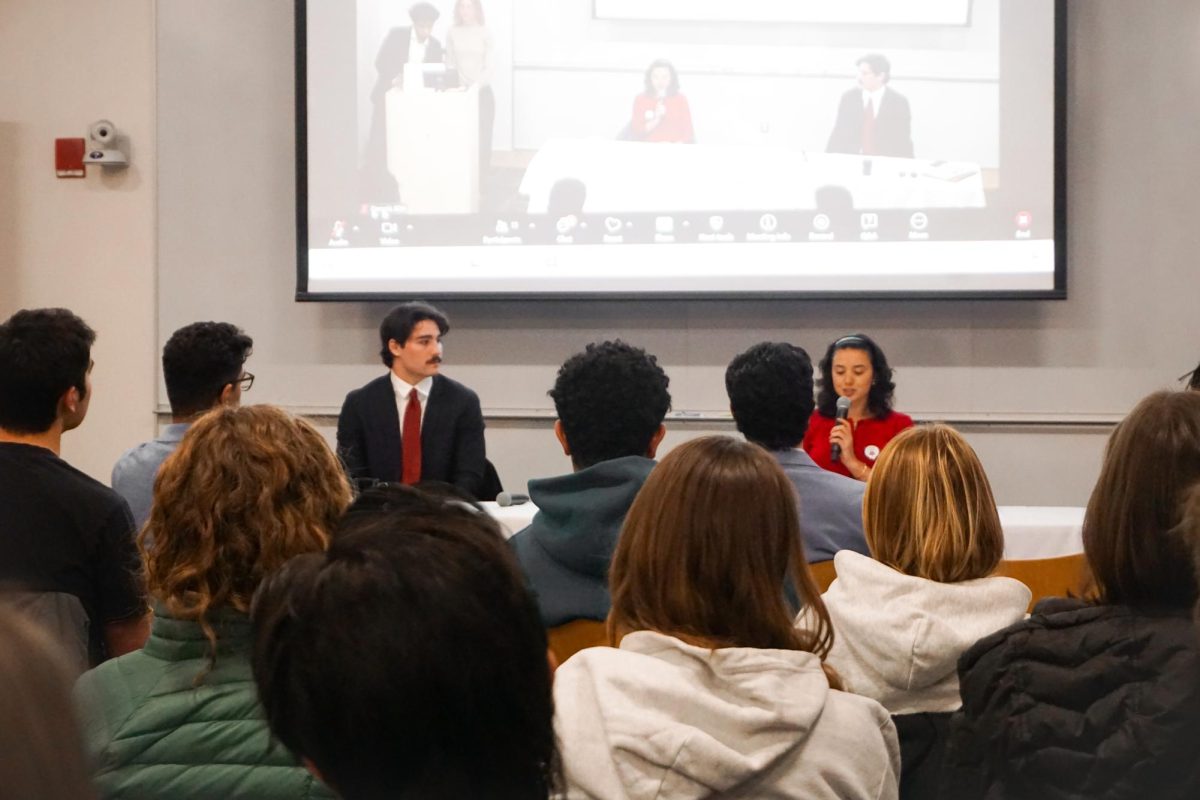
Bates College Student Government (BCSG) hosted their annual presidential debate on March 23. Seated at the front of the room, Ava Steinberger ‘27 and Miles Schmidt ‘27 faced off in the race for BCSG Co-President, alongside their respective running mates, Mohammad Zayd ‘27 and Salem Aqraa ‘27.
The debate was an hour long, moderated by Kate Schulze ‘26, chair of the Committee Selection Board, and Karan Kuppa-Apte ‘27, Committee Selection Board member. After opening statements, the six debate questions touched on issues of accessibility, inclusion and continuity before a half an hour of audience questions.
Steinberger detailed Zayd’s experience as acting Student Body President and her own as an Assembly Member in BCSG and beyond.
She said, “If elected, we promise to continue to use this passion and understanding to best serve the student body as co-presidents. We have built our platform partially on the work we ourselves have already done, but also on the great work we have seen others do, as well as the expressed needs and ambitions of others – which we want to help make a reality.”
Though he noted his lack of previous experience with BCSG, Schmidt focused on his leadership and fundraising experience on the Bates Men’s Lacrosse team, and his collaboration with Aqraa, an acting Committee Member, in his opening statement.
He said, “We believe, while maybe not being directly a part of student government so far from my end, to truly make change within a community, you need to be immersed within it and focused on the people.”

BCSG’s communication with the student body, long-term projects, and community building events were hot topics of discussion.
Steinberger suggested “more student surveys” and “more opportunities for students to connect with higher members of the administration… utilizing the Den Discussions and Chai Chats for that purpose,” as well as a feedback box in Commons.
Schmidt mentioned, “Something that is often overlooked is really just a Google Form. And I think what you can do is put those QR codes in places that are easily accessible.”
Addressing how to sustain initiatives beyond a single BCSG administration, Schmidt emphasized building relationships with future presidents and fostering and creating a “shared vision,” while Steinberger spoke on her ticket’s current positions and their benefit in ensuring continuity and efficacy of current projects.
During the debate, Steinberger voiced that she and Zayd are already working with Mayor Carl Sheline on new community outreach efforts and collaboration events between Bates students, institutions and local businesses and communities.
She said, “My running mate, Mohammad Zayd is the current co-president. So, if we’re talking about leadership and continuity, there isn’t really any stronger case than that.”
Reviving events like Bateschella, a student music festival, and Lost Valley Takeover is a major part of the Schmidt-Aqraa platform, especially in the pursuit of fun and inclusion. In both his opening statement and responses to audience questions, Schmidt repeated his dedication to these forgotten Bates traditions.
In a comment to The Student, Aqraa highlighted this as a particular area of focus. “We’ll do our best to bring back Lost Valley Takeover because it was such a crucial event for me. I never knew how to ski… when I went out there, I was kind of able to figure it out by the end,” Aqraa said. “It’s been here for 40 years, and we will do our best, whether that be pestering them with emails or just tracking down people… We will do our best to bring it back.”
Campus Life cancelled the Takeover last year due to concerns of accessibility to non-skiing Batesies after Lost Valley closed their tubing hill.

During the Q&A, students asked about the candidates’goals, current BCSG projects, and personal strengths and weaknesses. Steinberger spoke about her focus on securing free or subsidized laundry, and both candidates addressed concerns about the athlete/nonathlete divide, suggesting community events as a possible solution.
A first-year student asked about the inclusion of LGBTQ+ students on campus. “Many queer students on campus feel unheard, unseen, ignored,” he said. “For resources like SPARQ, attendance and acknowledgement have dropped… If elected, how would you make campus more comfortable for queer folks?”
Steinberger responded first, “We need to ensure every student here feels a sense of belonging. If our campus partners aren’t meeting that standard, we have to make sure they do… Also host more events, partnerships with such resources so we understand where there’s a lack and where we can advocate for resolution.”
Schmidt seconded Steinberger’s remarks, adding, “Bates is such a special place in the way that it brings so many different types of people together from different backgrounds. So I think to continue to use the resources that we have, but also … if you feel like the resources provided to you aren’t enough, that we can be a voice for you… let’s go find the things that aren’t working.”
In an interview after the debate, the first-year student, who wished to remain anonymous for personal safety, shared why he posed the question. “I’ve talked to a couple of SPARQ members and mentors, and they said that attendance has dropped, and so has acknowledgement on campus,” he said. “And in addition to that, a lot of stories have been coming out about facing discrimination from multiple sports teams…not to drop any specific ones, but [queer students] have felt discriminated by them.”
He continued, “During the inclusivity section, [Schmidt] failed to mention SPARQ, as opposed to Ava [Steinberger], who mentioned SPARQ… I asked that question because I feel like it’s really important for my peers who are queer to feel seen and feel heard.”
When asked about this question and his position as an athlete on a prolific men’s team, Schmidt said, “I wasn’t as specific as I could have been with being able to mention things like CAPS and Health Services and the SPARQ and student support advisors… To be a bridge between the people who may view men’s sports as something that is not accepting or supportive of those types of groups, I think, to be able to be someone that is at the crossroads of student government and athletics, I can be someone who can represent everyone.”
Directly following the debate, candidates shared their thoughts on their running mates’ performance with The Student.
Zayd expressed, “I think it went really well. I feel like Ava [Steinberger] was definitely able to be representative of our ticket and really put out our platform – explain our platform to the broader student body that maybe hasn’t been seeing our posts on Instagram or seeing our flyers around campus.”
He also drew attention to the upcoming BCSG restructuring. “I think it’s a pretty major change, because it truly is able to highlight student representation in both BCSG and the broader student body… It’s something that’s going to drastically affect student government and is going to majorly affect the incoming agenda of next year. And so that may have been a place that I would have loved to expand upon.”
The Committee Restructuring proposal, passed in February, involves student representatives in Dean of Faculty governed committees, dissolving the existing student subcommittees.
Aqraa commented, “I feel like it went really well. Like our overall theme of just being there for everyone and trying to bring the community closer together was exemplified really well by Miles [Schmidt]. He was well put together, and he showed everyone in the room that.”
Regarding preparation for the debate, Steinberger said, “Mo [Zayd] and I have both been here before, so we were able to reuse some campaign materials, some ideas, in preparation for this debate, and I think that it served us well. But honestly, I think what most helped me was just our experience both with debating in the past, but also just on BCSG in general. It’s all things that we talk about every day. And so it really just felt natural.”
On the same topic, Schmidt noted, “The preparation was extensive. I think it really came down to Salem [Aqraa] and I coming together and really just nailing down the things that we feel most passionate about as candidates and being able to actually put that on paper.”
The debate recording of the Zoom livestream is available online, in addition to statements on each ticket’s positions. Voting closes Thursday, March 26 at 11:59 p.m.and can be accessed through Bates Engage.