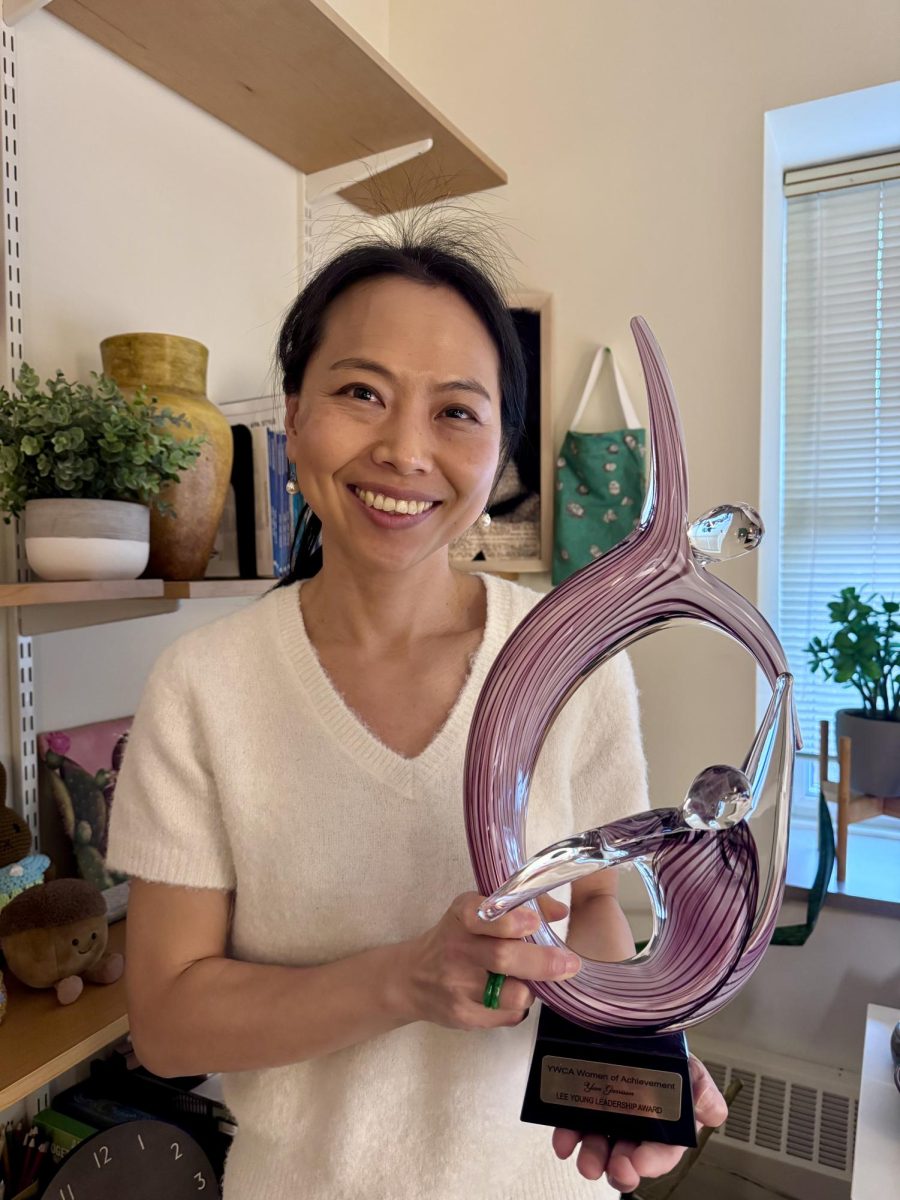
Assistant Professor of Psychology Yun Garrison received the YWCA Lee Young Leadership Award in recognition of her work on the Ka Bogso (Be Healed) initiative and her ongoing work on the Lewiston is Our Hope community art installation.
Garrison received her award on March 8 at an awards ceremony hosted at the Hilton Garden Inn Riverwatch in Auburn from the Young Women’s Christian Association (YWCA), a nonprofit organization dedicated to eliminating racism and empowering women. The Lee Young Leadership Award specifically honors “excellence in professional, community, civic, or artistic leadership.”
Upon hearing that she had won the award, Garrison said that she felt “overrated, but at the same time, really, really grateful for folks who view my work as important and meaningful.”
When asked what the award meant to her, Garrison said she saw it as “an invitation for me to continue loving and caring for neighbors in Lewiston, Maine, especially women, refugee immigrants–folks who may feel left out and marginalized in society.”
Eva Rodriguez ‘26, a member of the YWCA board, said, “What really spoke to the board… was her ability to effortlessly, really integrate the Bates community and Bates students and researchers with the Lewiston-Auburn community in a way that didn’t feel fully academic.”
“She just did an exceptional job of doing hands-on research that incorporated the Lewiston community, but also benefits the Lewiston community,” she added.

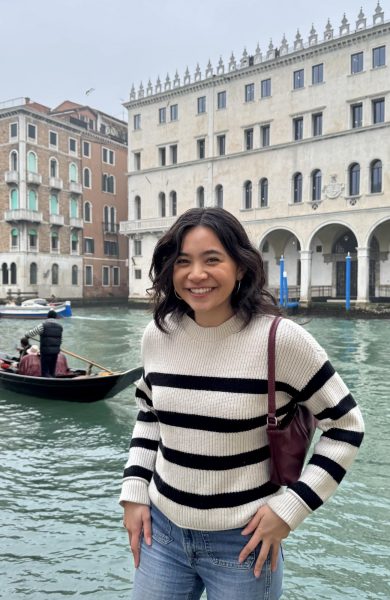
Yun Garrison, Fowsia Musse, Shadia Abdulahi (the bottom row from left to right) (Courtesy of Yun Garrison)
Ka Bogso (Be Healed) Initiative
Garrison’s award in part, honored her co-leadership of the Ka Bogso (a Somali phrase meaning “Be Healed”) initiative, an exhibit centered around five art pieces that visualizes post-traumatic healing and healing narratives. Garrison collaborated with Fowsia Musse, executive director of Maine Community Integration, on the project.
“Through storytelling, witnessing each other’s emotion, really affirming each other’s values and vision, we were able to identify one meaningful, tangible project, which is theorizing a process of healing and growth in the aftermath of traumatic events among refugee women,” Garrison said.
Musse had already begun to theorize a practice of healing and growth for refugee women based on her lived experience and personal relationships with refugee women and girls through her work. After meeting Garrison, she proposed a collaboration for developing this theory. Through visits to Garrison’s psychology classes at Bates and numerous conversations, Garrison helped develop the written component of this project while Musse did the oral conceptualization of the theory.
To make their theory of healing and growth accessible beyond academic journals and English speakers, the women decided to collaborate with a local artist to visualize their work.
“Visual art can be translingual beyond linguistic capacity, or sometimes constraints, people can still connect to something that art is expressing,” Garrison said.
The two held multiple community gallery showings in Olin Arts Center and Munka Studio in Lewiston.
Lewiston is Our Hope Project
The award also recognized Garrison for her ongoing work with the Lewiston is Our Hope Project, a community art installation centered around hope and healing.
With the help of over 37 community partners, Garrison hosted numerous community art workshops during fall 2025 in which 400 people drew something that represents hope in Lewiston or hope for Lewiston on a small wood circle. Participants also shared a one minute story about what this hope means to them.
Garrison is currently working on creating a visual archive with all 400 images and their accompanying audio stories. The 8’x8’ art piece, she said, is also set to be displayed at the Lewiston Public Library later this year.
“The purpose of this project is: Hope always coexists with darkness and hopelessness. Hope requires a lot of commitment to staying connected to community and yourself, your values,” Garrison explained.
The art is supposed to serve as a kind of community hope resource, or a “visual reminder” for when individuals might not be able to generate hope of their own.
“Someday you may feel very hopeless and dark, and you may not be able to generate your own hope—and there’s a community reminder that…there’s another person who was so committed to sustaining hope,” she said.
She noted that the project received overwhelmingly positive feedback from a sprawling range of participants. The oldest participant, she said, was 92 years old while the youngest was only 2. She found that though participants could be hesitant in being asked to draw something at first, they quickly were able to dive into the project.
Often, she said, before she could even finish saying the drawing prompt out loud, she could tell that participants already knew what they were going to draw. “That immediacy of accessing hope was so powerful for me.”
Garrison’s work focuses on community-engaged scholarship and teaching, especially concerning post-traumatic growth for people of diverse cultural-linguistic backgrounds. This focus, she said, is a product of her search for understanding of her own cultural, linguistic and gender identities. She said she specifically stays away from pathologies and medicalization and has a more community-oriented focus in her work.
With the Lewiston is Our Hope project, art serves as an alternative to medicalized healing. “A lot of healing approaches have been so medicalized, and I want to challenge that—we do need medicalized approach and treatment, but also [the] community inherently has power to support one another. [So I] really wanted to center and amplify the power of healing community,” Garrison said.
When asked about the power of art, Garrison said that it can “create room for people’s autonomy, self-definition, and meaning-making, especially when people’s inner experiences are not outwardly expressed through words for various reasons.” She added that it is also a mode for people to reclaim joy following a traumatic experience.
Reflecting on the project, Garrison said that she “fell in love with Lewiston” while working on it. Garrison, an immigrant from South Korea, noted that she is always looking for places to belong. “But while I was doing this project, I realized that I thought I was creating space for others, but I realized that I am feeling so welcomed by people who are here.”
After she wraps up her Lewiston is Our Hope project, Garrison said she will continue her collaboration with Maine Community Integration and Musse, as they work on building an asset-based program for refugee mothers. The program, she said, will equip refugee mothers with craft skills that will allow them to contribute to the workforce for sewing, embroidery, painting and pottery.
Editor’s Note: This story originally noted that the Lewiston is Our Hope project will be displayed at the Lewiston Public Library in April. Arrangements have since changed and the art piece will be on display later this year. The story has been updated accordingly.