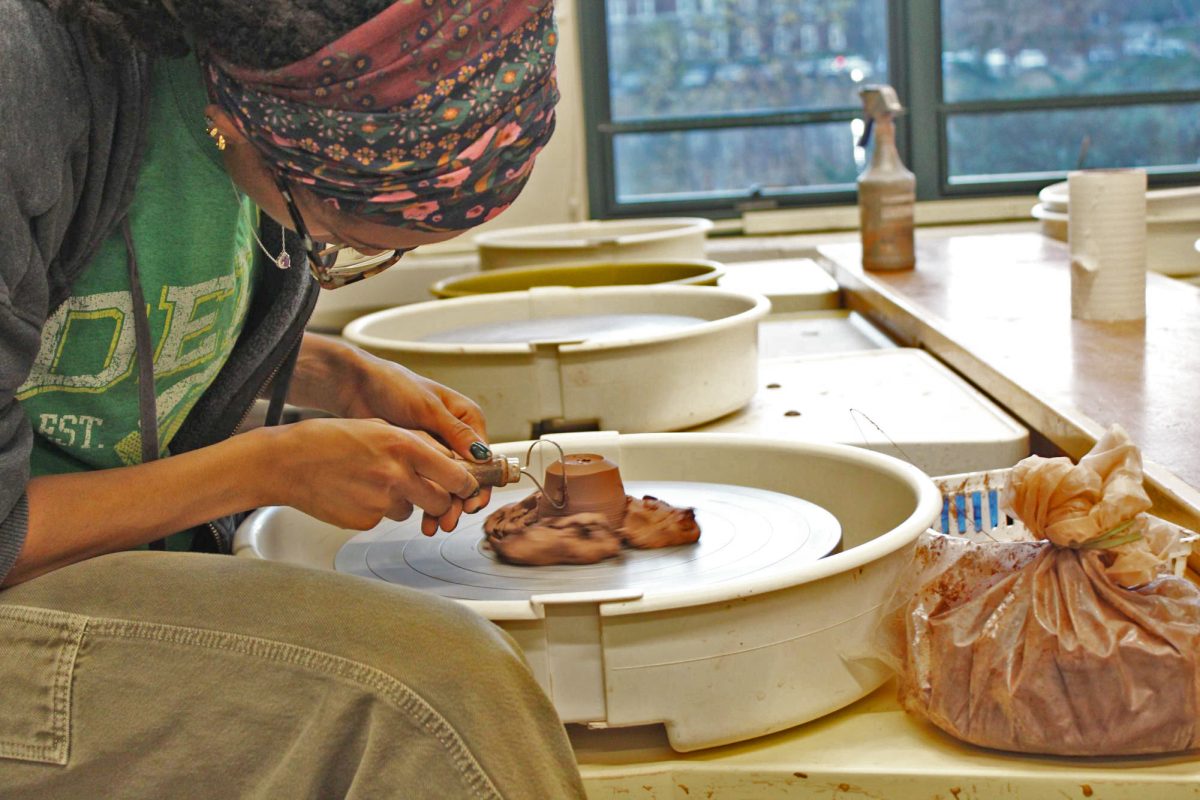
As of the Winter term of 2025, the Art and Visual Culture (AVC) Department has removed additional student fees that come with enrolling in a studio class and will no longer rely on students to cover the cost of supplies. In the past, this additional cost covered the cost of supplies like paints, canvas, inks, clay, tools or sketchpads. The fees ranged depending on the class, but could reach as much as approximately $150 per student per semester.
“It just feels wonderful to finally have a solution to this problem, to feel like students can come into our studios and have everything they need to make their work without worrying about how much it costs,” Cat Balco, Chair of AVC, shared with The Student.
Joanne Roberts, the Dean of Faculty, was a major player in promoting this change to the AVC department.
Roberts said that this move aligns with her central goal of increasing access for Bates students. “When we decide how to spend our budget, [access] is one thing that’s a priority,” Roberts said. “We’re making some strategic choices to make it possible for this to happen.”
Course fees can be a source of inequity, as some students are unable or unwilling to cover the cost of a class that they otherwise would be interested in taking. To be a Studio Art major at Bates, you must complete at least five studio classes and one AVC short term. When taking into account the financial commitment of studying AVC, some may be deterred from majoring or even taking a class.
“I know that some students haven’t enrolled in AVC classes because of the cost,” Balco said.
Sarah Smith ‘26, who took Ceramic Design and Techniques, Studio Pottery, and 2D Studio Foundations, elaborated on her experience with course costs.
“For 2D Foundations, I spent around $115 because I also bought a couple additional things that we needed that weren’t in the one kit. For ceramics, I spent around $25 on tools, and maybe around $30 on clay,” Smith said. She also shared that she reclaimed a lot of clay, meaning she recycled previously used clay to use it again, which saves money on buying new clay.
“We have an amazing studio program here, and amazing faculty,” Roberts said. “Cat Balco [and] I thought this should be a priority to make sure that art is accessible to all students here, and we should treat [AVC] in a way that is commensurate with how we treat course supplies in other disciplines.”
This updated policy has other benefits, as Roberts noted. “Not every single student will need to go and buy what they need. There’ll be supplies,” she said. “Then, anything that’s not used will be available for the next students. So it will be more economical overall for everyone, and better for the environment.”
“It’s going to get cheaper overall for everybody,” Balco echoed. Students will still be allowed to take their materials and tools with them after the class ends, but those who don’t have a use for them can easily donate to the next generation of studio students.
As a painting instructor, Balco spoke about how this decision influenced the dynamic of the classroom. In the past, asking students to use paint as sculptural material has created stress of wasting material, and therefore wasting a student’s money. Since the change in fee policy, Balco said, “it’s wonderful to be able to say to a student ‘use more paint’ and not feel that I’m also asking them to open their wallet and dump it on the ground.”
Balco continued, highlighting how increasing access to art classes strengthens Bates as an institution.
“The opportunity to participate in art and visual culture classes is a central part of a liberal arts education,” she said. “What we teach here is not extracurricular or on the side, but actually foundational to our mission here at Bates. And we are so grateful that it is now easier for students to access this kind of work, which every single one of them should access.”
Additional reporting by Aden Michael ’28.