
After weeks of discussion and revision, Bates College Student Government (BCSG) voted to restructure their assembly subcommittees and place BCSG representatives on faculty-legislated committees for the 2026-27 academic year.
The vote was initiated during the general assembly meeting on Feb. 11, with assembly members casting their votes via a Google Form that closed on Feb. 12. Final results were announced on Feb. 13 through an email to assembly members and The Student, with the proposal passing with 6 yays and 4 abstentions.
The vote follows the failure of an initial proposal which would have entirely dissolved BCSG’s internal subcommittees. The initial proposal faced significant disapproval from assembly members, who opposed this change, questioning the role of the assembly if members served on faculty-legislated committees alone.
Currently, BCSG’s subcommittees are composed of assembly members who meet outside of the general assembly meetings to work on special projects in their area of interest. Depending on what their project is, the committee members will reach out to senior administrators, staff and faculty members.
The final proposal replaces BCSG internal subcommittees with “assembly groups” which are organized according to the same themes as their subcommittees: student experience, academics, athletics and facilities.
Assembly members in these groups will each serve on corresponding faculty-legislated committees assigned by the Committee Selection Board (CSB), taking into account members’ committee preferences.
Assembly groups will meet and work on independent projects, taking into account the work they are exposed to on their individual faculty committees.
The assembly members will then serve on these same faculty-legislated committees until they graduate, assuming their re-election. At the beginning of each year, only new assembly members will be assigned to committees. If assembly members are not re-elected, they have the choice of remaining on their faculty-legislated committee but will no longer be part of their corresponding assembly group.
The faculty-legislated committees that would seat a BCSG Representative are organized into the categories of the assembly groups. The academics group would serve on the Curriculum Review Committee and the Library and Information Services Committee. The athletics group would serve on the Athletics and Arts Collaborative committees. The student experience group would serve on the Student Affairs/Campus Life and the Student Conduct Board committees. The facilities group would serve on the Campus Safety, Dining, Conferences & Campus Events and the Environmental Responsibility committees.
Assembly groups will be composed of between two and four BCSG assembly members, varying by year, according to the legislation. Each assembly group, in addition to meeting together outside of general assembly meetings, will be headed by a chair that will report to the executive board three times per semester to share goals, updates and reflections on their committees’ projects.
The final proposal maintained the structure of the BCSG subcommittees, with assembly groups functioning in the same way, while increasing assembly members’ role in college decision making by seating them on faculty-legislated committees and increasing their interface with faculty and senior administration.
The goal of seating BCSG assembly members on the faculty-legislated committees is to reduce the redundancies, inefficiencies and confusion caused by having BCSG subcommittees addressing the same areas of interest as faculty-legislated committees. The final proposal also posits that this structure gives assembly members an increased role in college decision making.
According to Co-Presidents Zach Richards ‘26 and Mohammad Zayd ‘27, senior administration and faculty have experienced confusion over the overlapping projects between BCSG and faculty-led committees, which made internal subcommittees unproductive in their view.
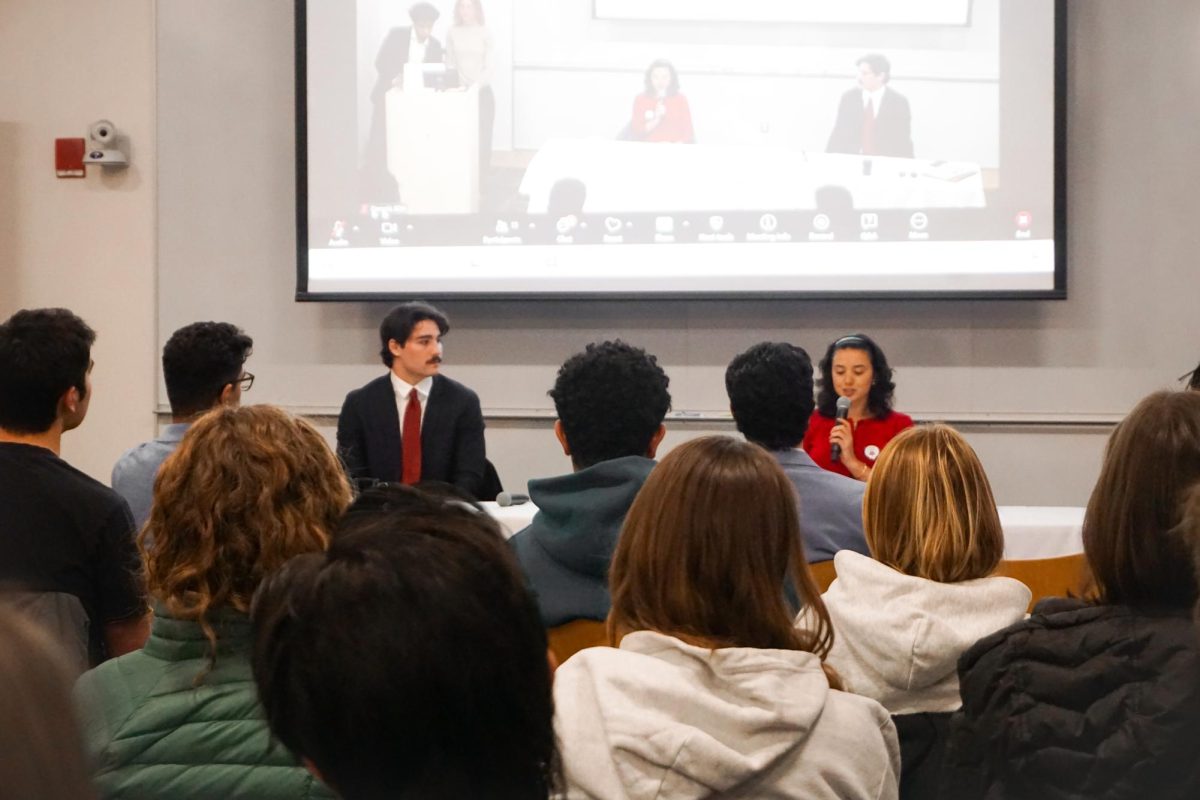
Senior Associate Dean of Students Kim Traucenik joined the Feb. 11 meeting to provide more clarification and insight on the final proposal. She emphasized that in the faculty-led committees, there has been a “missing piece” of student government representation. The restructuring, she noted, is meant to address this disparity while also ameliorating CSB’s difficulties with seating people on those committees.
Traucenik also said that there is currently no pipeline for information to be shared between faculty-led committees and BCSG, stating that having student government at faculty-led committees would put student government in direct contact with college decision makers.
“The goal of the committees is really providing you all with more access and structure to having the conversations that you’re having now and getting the input that you’re getting from your constituents now to make it more impactful,” Traucenik said.
The accepted proposal also keeps the President’s Advisory Committee (PAC) instead of eliminating it and transferring its duties to the BCSG E-Board. PAC, which is headed by one or two BCSG assembly members, is responsible for being a liaison between the president of the college and the student body.
The accepted proposal makes no mention of PAC. “That is going to be…something else that’s going to be worked out entirely separate to this proposal that we’re putting forth,” Richards said at the Feb. 11 meeting.
This change came from comments at the Feb. 4 BCSG assembly meeting, where representatives expressed their concerns toward dissolving PAC. Representatives discussed PAC’s struggles to hold regular meetings and fill seats on the committee. While assembly members agreed that PAC had some inefficiencies, assembly members maintained that it still fulfilled an important role in connecting students with senior administration.
In an email to The Student after the proposal had passed, Junior Class Representative Ava Steinberger, who heads PAC with Senior Class Representative Robbie Washburne, said that she was “relieved” that PAC had been left out of the legislation.
“Dissolving it would’ve been a shame, as I think it does really positive and effective work. So I am looking forward to discussing the potential ways we can improve its message and functionality,” she said.
She added that she hopes the restructuring proposal ultimately “affects some real change and improvements in the areas it is meant to target, especially given the amount of meeting time that was spent discussing it.”
In an email to The Student, Richards said that the BCSG co-presidents were pleased with the results of the vote. “We believe that the amended proposal, as voted on by the Assembly last Wednesday, ensures a balance between creating new opportunities for class representatives to participate meaningfully in college decisionmaking and maintaining the most important components of how the BCSG Assembly currently functions,” he wrote.
Richards added that this semester, BCSG will continue to lay the groundwork and prepare for its implementation.