This semester, the academics subcommittee of Bates College Student Government (BCSG) launched a free textbook loan initiative in Ladd Library.
Class Representatives Robbie Washburne ‘26 and Trinity Monstwillo ‘26 spearheaded the program with hopes of increasing accessibility and providing equitable access to textbooks for students. Washburne noted that though many Bates professors have opted for open source content in their classes, students, especially those in STEM courses, were still having to pay for textbooks.
“We wanted to figure out a way to create a more equitable textbook system and book system,” he said.
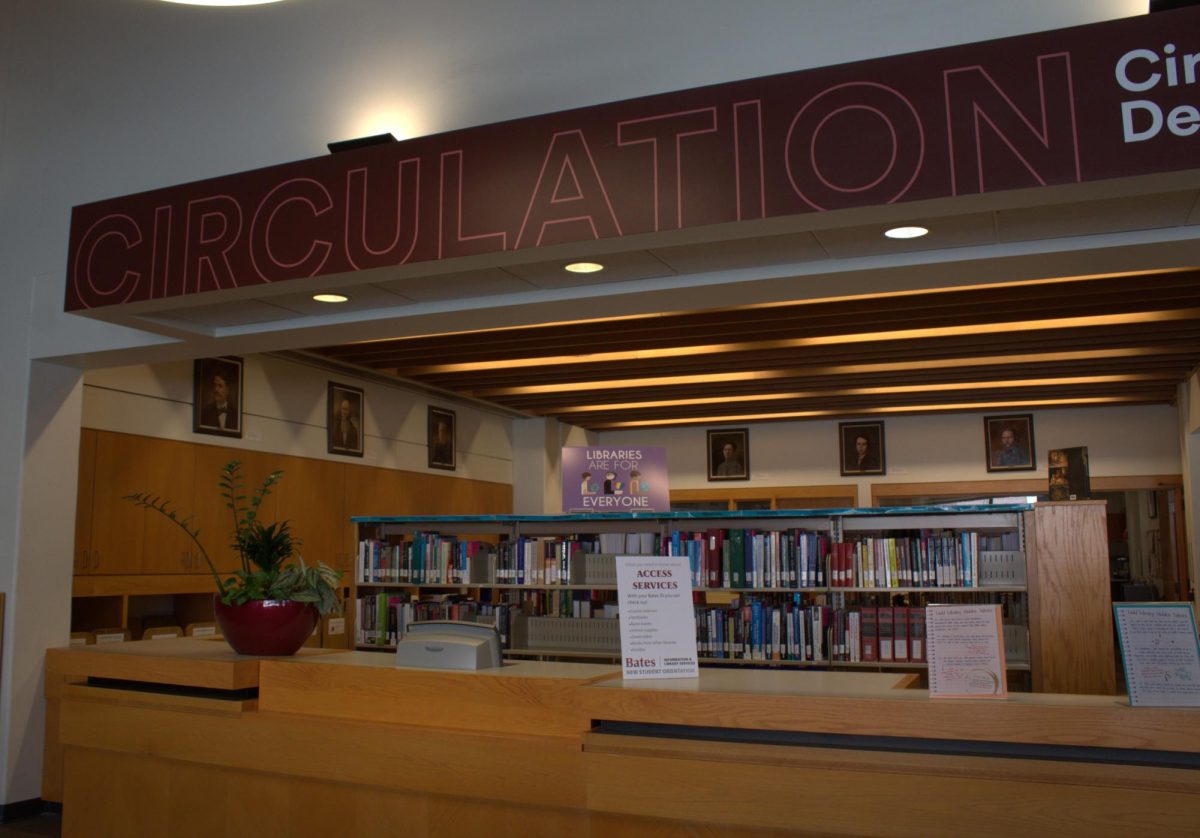
This initiative allows students to donate their old or unused textbooks at the library’s circulation desk. Others can then take these textbooks and materials out of the lending library and keep them for as long as they need. Once they are done with them, whether they need the material for a week, a month or the entire semester, the idea is that they will drop them back off at the lending library.
Washburne and Monstwillo said that while there is no official checkout system for the lending library, they hope that students will return materials when they are done with them.
Ladd Library currently allows students to check out course required materials from the “course reserves,” for up to two hours at a time. Many students use this resource to scan pages from books and avoid buying textbooks from their classes. Washburne and Monstwillo acknowledged the utility of the course reserves, but said that owning the textbook has its own merits.
“It’s one thing to get a textbook for two hours and scan the pages or something,” Washburne said. “But it’s another thing to feel the book in your hand.”
Washburne and Monstwillo also wanted to decrease the waste produced when students throw away unneeded textbooks or leave them in their rooms to turn into clutter at the end of the semester.
Though re-selling textbooks is an option for students that don’t want to throw them away, Washburne said that many of the students that he and Monstwillo talked to admitted that they didn’t go through the process of selling their books back to the bookstore.
Monstwillo added that with the new eCampus online bookstore, the book waste was going to grow. “If people weren’t gonna go and drop off their book at the college store originally, they’re not gonna go and take the extra step of shipping it back, either,” she said.
There have been various iterations of the free textbook loan program in the past, according to the library staff that Washburne and Monstwillo worked with. However, these previous loan programs failed due to difficulty managing them.
Washburne and Monstwillo said that they’re still working on the best way to address this issue. For now, members of the academic subcommittee are planning to visit the loan library every semester to take inventory of the books, discarding those which are no longer needed.
Additionally, there are still ongoing discussions about the best location for the loan library. Washburne and Monstwillo are hoping to put a bookshelf on the first floor of the library with a sign indicating how to use it.
The representatives said that the program is going to take some trial and error to perfect and that this semester is serving as a pilot for it.
“If people do it, and people are receptive, that’s gonna be amazing and awesome. But if it doesn’t [work], we’re not also gonna add extra pressure onto the staff here and for something that the students don’t generally care for,” Washburne said.
The two are anticipating an influx of textbook donations at the end of the semester as students finish up their classes and begin to clean out their rooms.
Currently, the lending library is accepting donations. Books can be dropped off at the circulation desk to a library staff member. Washburne and Monstwillo noted that students should specify that they are donating the book to the free textbook loan program when they do so.
Editor’s Note: An earlier version of this article misspelled Monstwillo. It has been corrected