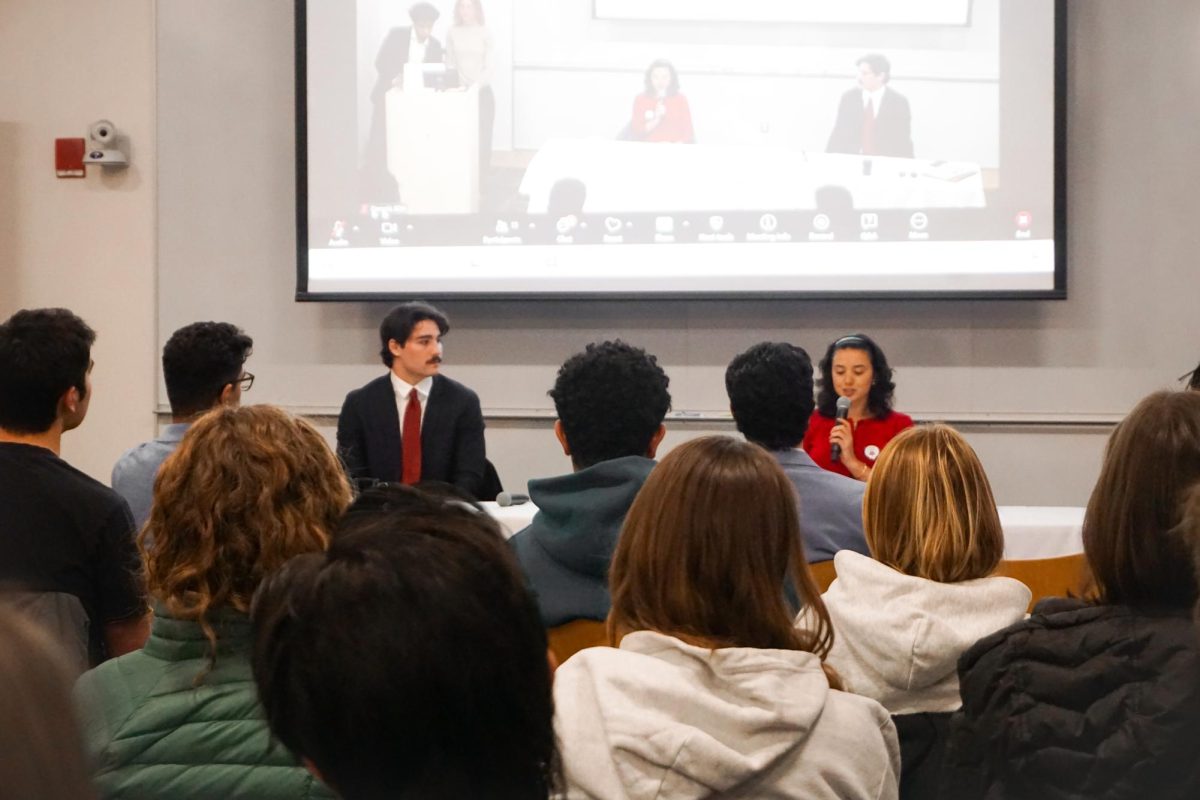
On Feb. 2, faculty convened for their monthly faculty meeting. Much of the legislation passed involved faculty governance.
1. Follow-Ups to Jan. 28 False Threat
On Jan. 28, at 9 p.m., the campus emergency notification system sent out the message “Bates College. False Report of threat at Ladd Library; LPD on scene and confirms all clear.”
President Garry Jenkins addressed the event as part of his updates at the meeting. Jenkins described it as a “swatting incident,” and explained that the term describes “a prank to call emergency services in an attempt to bring a large group of armed police officers to a particular address.” Law enforcement was able to quickly get to the scene and determine no credible threat.
A number of college campuses have been the targets of this type of false report in the past few months, including a few in Maine the previous week. Swatting is typically seen as individuals finding humor in causing law enforcement chaos, but ABC news reported in August that a group of campuses targeted between Aug. 21 and 25 were “very likely” the result of a single coordinated “swatting group,” which may have gained notoriety and revenue from the events. Others have reported school swatting incidents can be highly traumatic for Gen Z, due to their experiences with school gun violence.
Jenkins did not speculate about the identity of the culprit, but focused instead on a communication issue the event highlighted. Jenkins indicated that emergency communication systems did not alert Campus Safety to the issue though Campus Safety saw the arrival of Lewiston Police Department (LPD) and assisted them. He shared that Campus Safety is now working directly with the LPD to design better communication strategies that would quickly alert Campus Safety and administration about emergency situations.
2. General Education Concentrations (GEC) To Be Called Concentrations
The Academic Affairs Council, which sets long-term academic priorities and curriculum standards and policies, proposed a name change from General Education Concentration (GEC) to simply “Concentration.”
The name change arises from concerns that the GEC acronym is not understood by other colleges and universities or by future employers, nor is it recognized by potential students or new faculty. Additionally, “general education,” as defined by the New England Commission of Higher Education (which accredits higher education institutions including Bates), is a balanced breadth of subjects across humanities, sciences, social sciences, and arts. The proposing committee highlighted that GECs generally highlight a particular focus of study, rather than a focus on exploring a range of subjects.
Intended to clarify, the name change would also serve to make the naming of GECs consistent across all systems. A GEC already appears in Bates’ official transcripts as a “Concentration,” and though the Registrar has found that some departments used the term “concentration” to describe a set of courses within a major, those departments have already changed and now use the term “track” instead.
3. New Dean of Faculty Shares Second-Semester Plans
Dean of Faculty Joanne Roberts spent some time discussing the upcoming semester, thanking those in attendance for a welcoming first semester at Bates before diving into a quick overview.
First, Roberts announced her continuing plans to meet with faculty in small groups to hear directly from them about target areas and strategies for change.
Roberts then highlighted ongoing work and a multitude of initiatives, providing faculty with a point person to contact for each. These initiatives centered around supporting faculty and academic staff, maintaining and enhancing enrollment, and improving the student experience.
Support for faculty and academic staff included more than seven key initiatives, including supporting research, streamlining reappointment, tenure, and promotion processes and clarifying mentoring strategies. Initiatives to maintain and increase enrollment centered around “telling Bates stories,” which includes making more legible the opportunities of a Bates education to both prospective students and current Batsies and refreshing academic webpages to highlight existing departments, arts, and research.
In reviewing improvements to the student experience, Roberts mentioned current revisions to the course registration process in order to streamline the process and make it less “traumatic” for all involved, which is set to take effect this summer. Other improvements are set to include strategic removal of bottlenecks to enable student access to courses and majors they want to take, creating a smoother transition for transfer students, strengthening student advising and facilitating transfers of external credits.
4. Student Affairs Updates on Misconduct
Student Affairs reported on statistics from the fall 2025 semester, the first time student misconduct is being recorded under the 2025 revision to the misconduct resolution processes.
The revision completely overhauled existing pathways for addressing misconduct, moving from seven pathways to three and revising processes to address lack of clarity and outdated practices like carceral language and modeling live court hearings. They highlighted that comparing data pre-revision and post-revision is “like comparing apples to oranges,” in that the meaning of data points has changed under a complete overhaul of the previous system. For example, when a case is brought to Student Affairs, they investigate, either by meeting with students involved or, in the most serious cases, initiating disciplinary resolution with a trained investigator. If students are “found responsible,” the office then takes disciplinary action or sanction.
They reported that, of the 90 findings of responsibility, the vast majority of cases resulted in a warning. While this semester’s total case count is higher than the office has seen in recent years, Student Affairs noted that 65 of these cases were generated as part of room inspection processes during winter break room checks, mainly where hard alcohol was seen in plain sight in rooms belonging to students over the age of 21. Bates’ Alcohol and Cannabis Policy bans hard alcohol for students of all ages.
Student Affairs also reported findings of responsibility in three cases of academic misconduct.
5. Faculty Updates to Governance
The governing body of the faculty consists of a number of committees with specific responsibilities, to which there were a few changes this meeting. One of the faculty support centered committees clarified its language about their responsibilities and goals. Another committee working with the Registrar added a Registrar staff member to the committee’s convening team.
Additionally, the Committee on Faculty Governance (CFG) introduced new legislation, which comes after many years of considering related legislation, to open the conversation to determine record-keeping practices for faculty meeting minutes. Access to records has recently been complicated by a move to digitization, but current capacities do not enable faculty members to access faculty meeting minutes effectively, nor is there legislation determining how and to whom these minutes are made accessible.
Given Bates’ parliamentary system in which faculty meetings determine the legislation that governs the school, record-keeping practices for these meetings will impact campus-wide access to information about the past and current legislation all Batesies operate under. For example, faculty records might close to anyone other than faculty and staff or only be opened after 75 years have passed, as with Bates’ Board of Trustees policy for committee files. This legislation was framed as an opening for faculty to legislate these considerations.