
With Election Day fast approaching, it’s important for voters to be informed about the ballot measures up for a vote this Nov. 4. Androscoggin County voters, who include those registered to vote in Lewiston, will be deciding 2 questions, generally referred to as Q1 and Q2 in informational and promotional materials. Briefly, Q1 deals primarily with changes to elections in Maine moving forward.
Titled “An Act to Require an Individual to Present Photographic Identification for the Purpose of Voting,” this question is quite extensive, proposing an extensive list of changes to voting including requiring “certain photo IDs” on the day of voting, multiple restrictions to absentee voting, and “other changes to our elections.” To read the full initiative, visit the Maine Citizen’s Guide to the Referendum Election on the Secretary of State’s site.
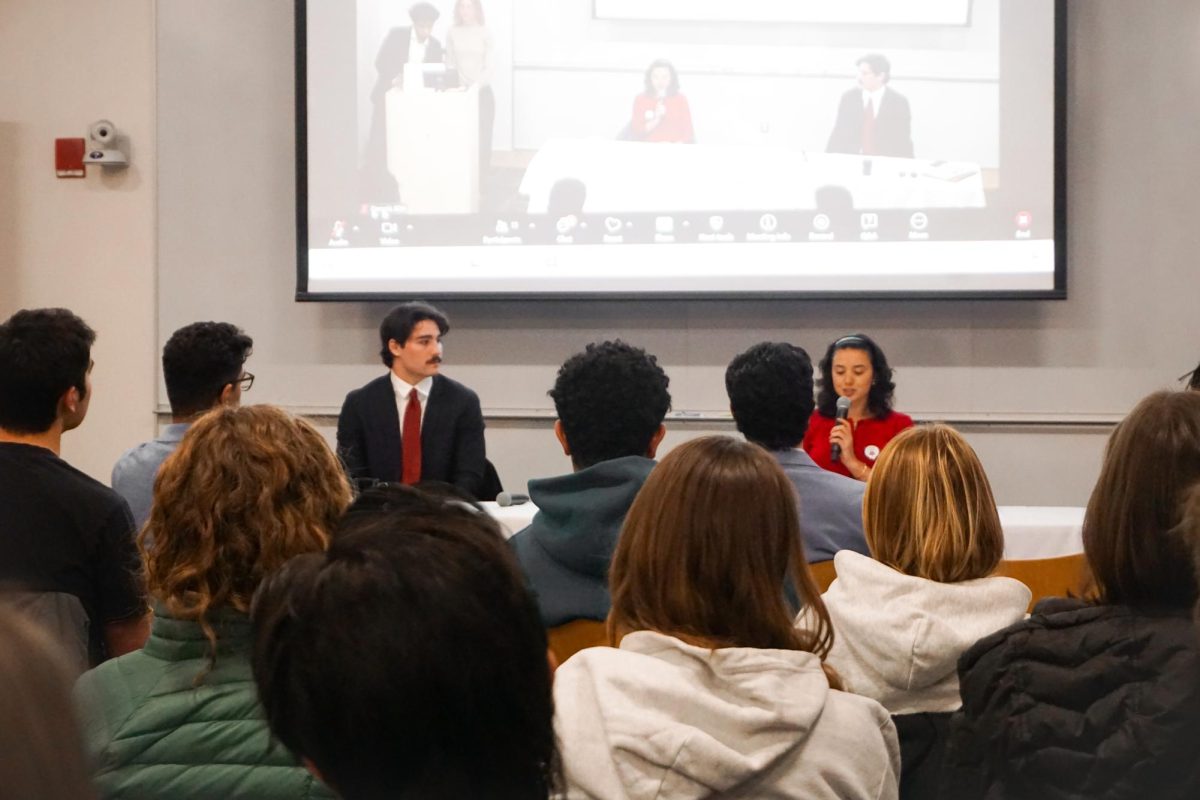
On Monday, Oct. 20th, Bates held the 2025 Ballot Referendum Forum in Muskie Archives. There, Emily Bader, a reporter for The Maine Monitor, broke some of this down into 2 significant topics of changes, voter ID and absentee voting. Bader also recommended checking out resources from the Secretary of State and her own reporting on The Maine Monitor’s website for a comprehensive examination of these changes.
How Q1 Would Impact Voter ID?
While photo ID is currently needed to register to vote, Q1, if passed, would require voters to bring one of the following five forms of Photo ID with them to the polls on election day in order to vote: a Maine driver’s license, a Maine non-driver identification card, a Maine interim identification card, a U.S. passport or passport card, or a military or veteran identification card. Notably, this does not include Student ID, Tribal Member ID, or Department of Corrections ID. Incarcerated individuals in Maine can vote, but are legally required to have a Department of Corrections ID that voids any valid State ID they might have, including for voting purposes.
Critics of Q1 have raised concerns about voting access, especially for populations relying on these IDs or belonging to marginalized communities. Those in favor of Q1, however, argue that restricting valid IDs and requiring it on the day-of is a necessary measure to prevent election fraud or that it is necessary to encourage public faith in elections. Critics have pushed back against these lines with reputable research, which fails to substantiate claims of widespread voter fraud.
As pointed out by Bader at the Bates Forum, this is particularly salient to Bates students voting in Lewiston. Currently, as with other voters, students are required to register to vote with either a Maine driver’s license, Maine State ID, or the last 4 numbers of their Social Security number. However, on the day of voting, students can use the voting badge on Garnet Gateway as a proof of residence in conjunction with their student ID. The voting badge, developed through the combined efforts of the college’s Registrar and the Secretary of State to provide that link between student IDs, their physical address, and legal name.
While this is helpful for students who do not have Maine State ID, this is especially necessary for students living in campus housing, who are unlikely to have the necessary utility bill equivalent typically expected to prove residence. Additionally, the voting badge solves particular challenges faced by students using non-legal names, often called “nicknames” or “preferred names,” on their school ID.
It is currently not clear how exactly Question 1 would change the validity of voter badge. If passed, it may require one of the restricted forms of valid ID, which would render students relying on Student ID unable to exercise their right to vote, even if they had registered with valid ID previously.
The same issue applies to voters relying on other currently acceptable forms of ID, such as Tribal Member ID or Department of Corrections ID.
Dr. Lucy Britt, an assistant professor of politics at Bates, highlighted the historical and political context within which voters might also consider this question during the forum.
From the founding of the United States of America until the Voting Rights Act of 1965, there was highly limited voting rights in the country. While the ratification of the 15th amendment enshrined voting rights for all male citizens, these rights were not enforced following the removal of Northern troops from Southern states. This involved widespread disenfranchisement, most especially for Black voters in the South, Latino and Hispanic voters in the West, and Indigenous communities nationwide. The practice of this disenfranchisement involved creating hurdles to prevent people from voting rather than explicitly barring them, literacy tests being one such example. In 1965, The Voting Rights Act not only explicitly protected minority voter’s right to vote, but it also granted the government the right to preclearance, essentially the power to preview and veto proposed changes to voting laws for states with a history of voter suppression.
When considering voter ID laws, Dr. Britt noted, it’s important to understand the context of the 15th amendment. This right to vote was passed at a time when the Freedman’s Bureau, following the 14th amendment, sought out freed men to ask them to vote. The voter identification they required: an oral oath that each person was who he said he was.
What Would Q1 Do to Absentee Voting?
Typically, absentee voting in Maine helps meet the needs of a wide variety of voters for whom getting to the polls on Election Day is challenging. This is largely necessary for voters with disabilities, over the age of 65, currently in armed service or the dependent of those on active military duty and overseas voters. However, absentee voting is also helpful for those working shift work, who might otherwise need childcare to show up to the polls, or living a significant distance from their voting site, as may be the case in a significantly rural state such as Maine.
The proposed changes in Q1 would prohibit municipalities from having more than 1 drop box, prohibit the provision of prepaid postage, require a photocopy of one of the five valid forms of photo ID, and roll back the ongoing absentee voter program. The program, for those who have applied and qualified as having a disability or as being at least 65 years old, sends absentee ballots automatically to those individuals as long as they maintain their status.
The proposed changes would also create a “bipartisan team of election officials” to deliver absentee ballots to the clerk’s office from the drop boxes, instead of the current system, where that is the role of the municipal clerk, who is a nonpartisan official democratically elected by the municipality. Further details on the “bipartisan team of election officials” are not specified.
Critics of Q1 have primarily expressed concern about restricting absentee voting. Proponents of Q1 have generally argued that the proposed restrictions on absentee voting are either distractions from the real measure of stricter Voter ID or are not actually going to impede access.
Likely Effects of Question 1
During the Oct. 20 forum, Dr Britt also synthesized relevant political science research related to these proposed Voter ID and Absentee Voting changes.
Regarding concerns of unsecure elections, Dr Britt shared, “Reputable research shows no evidence of widespread voter fraud in the U.S.”
A high risk, high punishment crime, voter fraud is also not enough to swing elections at the existing estimated rates; one in 2.5 million in-person votes might be illegal and one in 400,000 mail-in votes might be illegal, explained Britt.
The Voter ID changes proposed this election classify as “strict” under the Voter ID categorization of the National Conference of State Legislatures (NCSL), said Britt. According to the NCSL, this means that if a voter fails to show the ID that is asked for by law, as that voter “must vote on a provisional ballot and also take additional steps after Election Day for it to be counted,” which may include returning to an election office within a few days to present an acceptable ID.
Nationwide, 11% of eligible voters don’t have the ID requirements necessary. This is higher among seniors, racial minorities, low-income voters and students, according to Britt.
Likely effects of “strict” Voter ID law is mixed, Britt shared during her talk, indicating that impacts vary across states, voter groups, and political contexts. While some studies find that voter ID laws lower turnout, some noting this effect especially among certain groups like minorities and Democrats, other studies find null effects. In the latter case, Dr Britt explained that “one study finds that when they perceive their vote is being threatened by voter ID laws… Democrats and minorities vote at higher rates.”
Dr Britt also highlighted current research, as it may also indicate likely effects of the changes to absentee voting: among voters who are essentially in person, absentee voting drives up turnout without significant effects along party lines and limiting drop boxes may decrease turnout by 3-5%, particularly impacting disabled, female, low-income, and minority voters the most.
Next Steps to Voting
Check out the Bates Student article on Voting as a Bates student in Lewiston for more information on how to vote, or reach out to Bates Votes at the Harward Center or via email [email protected]. A notionally-recognized, nonpartisan, student-led voting initiative designed to connect all eligible students to the resources they need to exercise their right to vote, they have also developed the 2025 Bates Voter Guide. You can also check your Election Day polling place the Maine Voter Information Lookup Service.