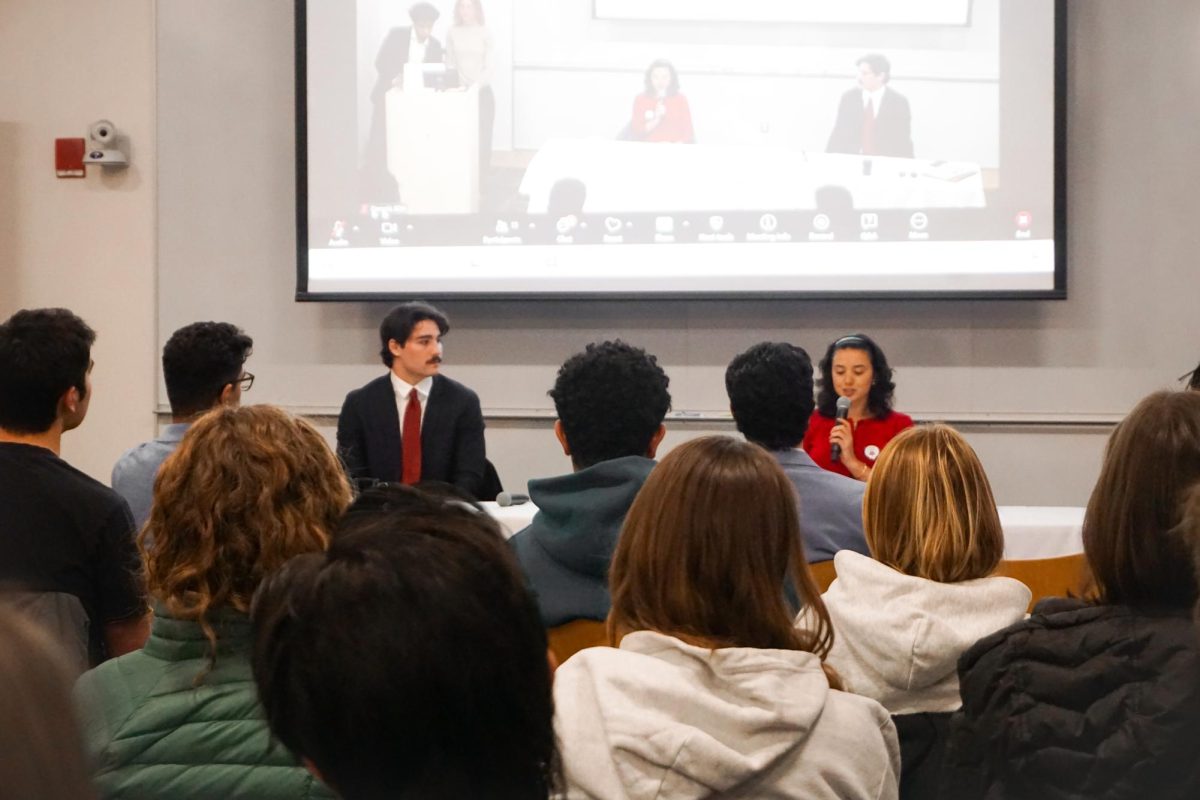


On the snowy Monday morning of Martin Luther King Jr. Day, Bates students packed into Memorial Commons to attend the panel, “Reel Talks: Love Anger and the Struggle for Justice: Sinners”.
One of the workshops offered as part of Bates’ 2026 MLK Jr. Day observance, the panel discussed Ryan Coogler’s 2025 film, Sinners, exploring themes of race, sex, colonialism, and generational trauma. Panelists included Stephanie Kelley-Romano, professor of rhetoric, film, and screen studies, Charles I. Nero, professor of rhetoric, film, and screen studies, Dale Chapman, professor of music, Matthew Fox ’26, Bella Saul ’26, Aidan Stark-Chessa ’26 and Braedon Parker ’27. In organizing the panel, Professor Nero said he asked for volunteers from his fall course, “White Redemption: Cinema and the Co-optation of African American History,” to help facilitate conversation.
The film follows twin brothers who return home to Jim Crow-era Mississippi after chasing fortune, hoping to open a juke joint to gather and celebrate blues music. Their vision of a safe-haven, however, is quickly threatened when it attracts a greater evil in the form of vampires seeking to infect and corrupt them, turning the night into a fight for survival.
The panel covered the film’s central themes of love and sex, utopia and capitalism, and race and colonialism. For each major theme, they screened a clip from the movie before offering their insights, accompanied by questions and comments from the audience.
When discussing the themes of utopia and capitalism, the panelists showed one of the most genre-bending, creative scenes in the film in which the character Sammie begins playing a blues tune, summoning musicians and performers from all different cultures, time periods and musical styles.
Commenting on the scene, Professor Chapman explained that this moment is piercing the veil between past, present, and future and ultimately connecting those that are in the juke joint with both their ancestors and musicians to come.
Bella Saul ‘26 spoke on the ending of the scene, where the three white vampires look upon the juke joint from afar, symbolizing the envy and historical white commodification of Black music and culture. She explained that enslaved people often used two routes of healing from the violent past in the forms of Christianity and music. This scene, she noted, uplifts music as something that is “spiritual in a way that invokes the history of West Africa and of the transatlantic slave journey, where, just as crops and people were brought from that place, so was music.”
The panel concluded with a discussion of the question: Is existing in a monstrous form preferable to existing under racial domination and colonialism? This question generated a lively discussion with one audience member noting that when Stack offers Sammie the chance to live forever and he declines, this suggests that this monstrous existence without pain comes at an enormous cost.
The discussion participants concluded that what the vampires really want is to be a part of something, rather than to have something be a part of them. Stack trying to turn others into vampires shows that existing in this monstrous form only works if the people around you are also willing to make the sacrifice.
The discussion created a space where film served as a medium for grappling with the large and nuanced topics reflected in this year’s MLK Jr. Day theme, “Love, Anger, and the Struggle for Justice.” By the end of the panel, the discussion felt less like a film analysis, and more like a shared experience of pure excitement and intellectual conversation that only a truly original film like Sinners can foster.