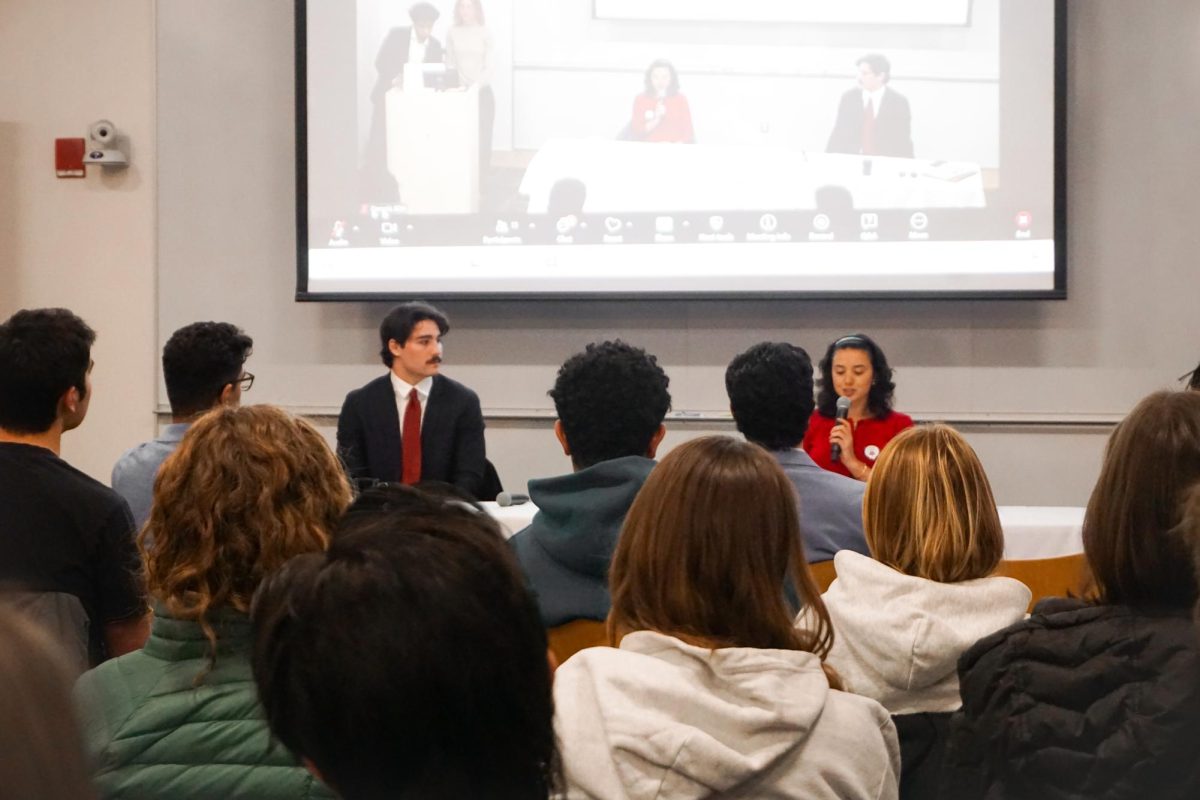


As part of its Martin Luther King Jr. Day programming, Bates College hosted its annual Rev. Dr. Benjamin Mays Debate in Olin Arts Center on Jan. 19.
The debate is an opportunity for students from Bates’ and Morehouse College’s (Dr. King’s alma mater) debate teams to come together and honor Benjamin Mays and Dr. King. Framing the debate through the legacy of civil rights leader and alumnus Benjamin Mays, who graduated from Bates in 1920 and went on to become the President of Morehouse College in 1940, the two teams engage in a debate topic relevant to today’s world.
This year’s topic was, “Resolved: This House believes that social justice movements should practice a politics of anger.” Based on this year’s MLK Jr. Day theme, “Love, Anger, and the Struggle for Justice,” the topic connected historical civil rights struggles to contemporary political and social movements.
Arguing for a practice of anger were Bates’ Tosca Neumann ‘26 and Morehouse’s Acie Abner ‘28. Arguing for the opposition were Bates’ Tanvir Thamid ‘26 and Morehouse’s Junias Lunsford-Peaks ‘28.
Opening for the Government position, Neumann argued that anger, when organized, is a necessary political resource for social justice movements. They frame their stance in controlled anger, arguing, “We are not defending a political fury or rage, one that is violent, uncontrolled, and hateful. But the politics of anger…can take many forms, including the use of language that doesn’t appease, but rather confronts the oppressor by using aggressive strategies of non-violent civil disobedience.”
Neumann referenced Dr. King’s teachings, claiming that he never warned against anger being bad, but rather against the destruction of unorganized anger. Tosca’s words engaged the audience, allowing them to apprehend their passion through the clarity of her explanations. To end, Neumann left listeners with the phrase, “ Love can be hopeful but anger is what gets us there.”
Opening for the Opposition was Abner, one of the representatives of Morehouse College. Abner opened his arguments, claiming “Anger when institutionalized as a political strategy, is like fighting a fire to see in the dark. It may provide an immediate illumination, but ultimately it will burn down.”
The opposing team’s opening claims centered around the idea that anger polarizes movements, shrinks participation and weakens public support. They moved to support a “politics of communication” centered on dialogue and durable reform.
Through the use of metaphors, Abner created an impact with his words, arguing, “Anger moves fast, but it does not move wisely, like a car with a stuck accelerator and no steering wheel, it very well may surge forward, but it absolutely cannot control where it is going to end up.”
Beginning with the rebuttals, Abender represented the Government’s position. Abender rejected the opposition’s characterization of anger as inherently violent, stressing a distinction between organized anger and uncontrolled rage, arguing, “It was not that they were consumed by anger. They were very strategic, in the way that they placed these movements, for people to understand the agency and the urgency of what was going on in this moment.”
The government’s position used the rebuttal opportunity to use civil rights movements as a grounding to explain the necessity of anger in political movements. Ending their time, Abender argued, “It is not enough to just say you love someone and say you love your brother. You have to actually stand on what it is that you believe. You have to take action. And that is what you get when you take on the politics of anger.”
The debate concluded with the rebuttals of the opposing team, represented by Thamid. Opening his arguments, Thamid pulled sentiments from Martin Luther King Jr., arguing, “When Martin Luther King Jr stood at the Lincoln Memorial, he did not say ‘I’m angry.’ He did not say ‘You’re evil…’ He said ‘I have a dream,’ and this is exactly what the opposition stands for.”
Throughout the debate, both teams presented their arguments with remarkable eloquence and rigor. However, what truly resonated was the profound personal insight Tanvir brought to his rebuttal, lending it a deep authenticity that moved the hall.
In his argument, he claimed, “When I was protesting in Bangladesh, and the state opened fire against us, the reason why the state could not justify their violence is that we were being peaceful. It’s because they fired on people without any weapons. That’s how we said that their violence is unjustified, they don’t get to kill us.”