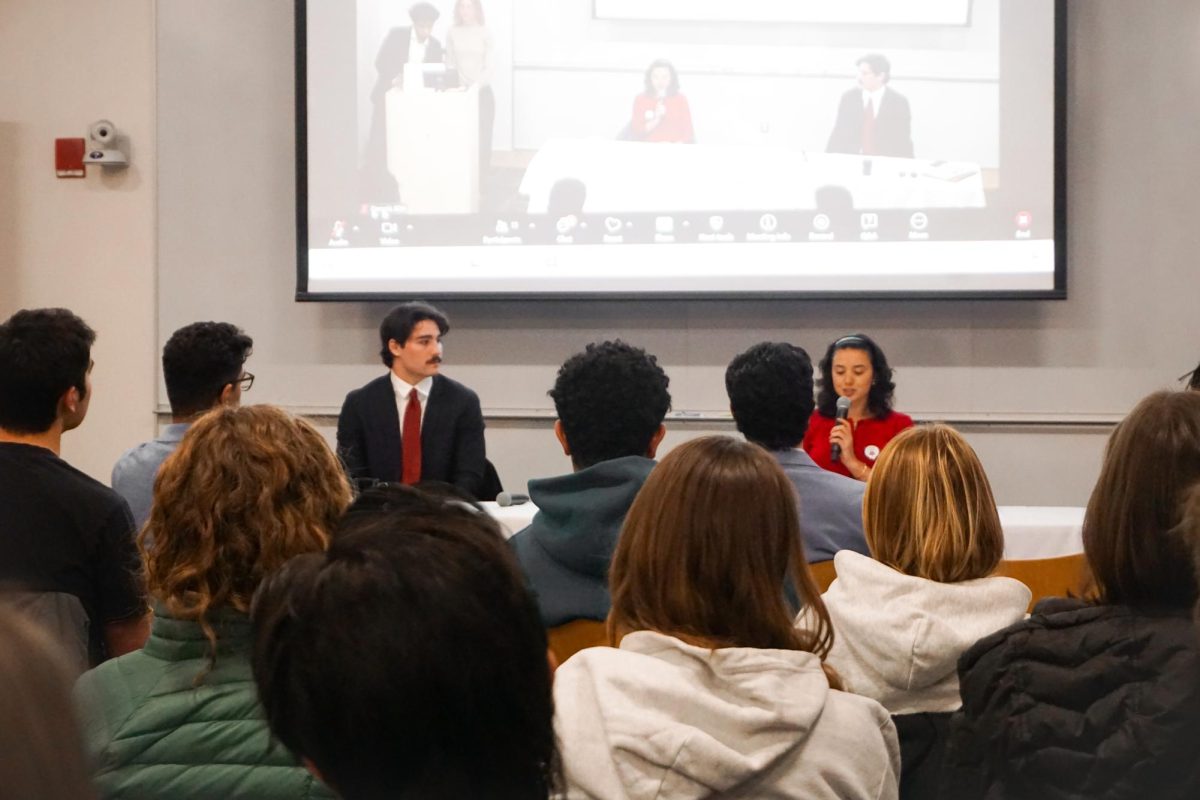


On the afternoon of Monday, Jan. 19, the Chase Lounge was filled with anticipation for a panel discussion titled “Race, Buddhism, and Sexuality in The White Lotus, Thailand Season 3”.
Offered as one of many workshops part of Bates’ Martin Luther King Jr. Day observance, the panel dissected how characters in the popular television series The White Lotus interacted with concepts such as Orientalism, anti-black sentiment, Buddhism and sexual taboo.
The panel members included Professor of Rhetoric, Film and Screen Studies Charles Nero, Professor of Religious Studies Alison Melnick Dyer and two students in the religious studies department: Shay Campolongo ’26 and Matt Riseman ’26.
After viewing selected clips from the show, panelists spearheaded poignant analyses and discussions where the crowd was enthusiastically invited into conversation. The dialogue was so spontaneous and natural that, to the regret of Professor Melnick Dyer, only half of the intended slides were covered.
When speaking on the content left out of our eighty-minute discussion, Professor Melnick Dyer told The Student that she wished for more time on discussing the representation of the local community and “how Buddhism exists in different people’s lives” outside of predominantly white tourism in Thailand.
Further discussing the portrayal of race in the TV-series, Professor Nero reminded the audience that the television series does not exist in a vacuum and is constantly in conversation with past works. He proceeded with an intertextual reading of the series with the famous Langston Hughes poem “Harlem,” comparing one particular scene side-by-side with Lorraine Hansbury’s A Raisin in the Sun. These analyses brought a unique racial lens to the discussion, leaving attendees with insightful reflections and more lingering questions than they came in with.
The discussion was initially conceived through a conversation between friends, when Professor Nero asked for Melnick Dyer’s opinion on the representation of Buddhism within the season— a topic of recent popularity in Buddhist academia.
This year’s theme for MLK day being “Love, Anger, and the Struggle for Justice”, Professor Melnick Dyer was interested in how the show uses– and more importantly omits– Buddhist philosophies on processing those emotions. “What can our anger teach us?” she asked. “How do we handle our anger? How do we deal with it when we see injustice in the world?”
When asked about what initially sparked this panel as an MLK day workshop, Professor Melnick Dyer spoke on the pertinent portrayal of race and racism in the season, as well as an urgency to hold popular culture to scrutiny.
“It’s important for us to be interrogating popular culture”, she said, “because it does have an effect, often a significant effect. And so I was seeing folks I knew in the audience and thinking, ‘How is this affecting that person? How has this show impacted them?’”
Melnick Dyer added that she was surprised with the turnout of the event and how the crowd reached very different readings even when viewing the same scenes. Specifically, she was astonished at “how much our own personal, lived, embodied experience influences what we’re seeing and how we’re perceiving it”, echoing back to MLK Jr. ‘s dream six decades ago that celebrated our individual differences while rejoicing in a shared humanity.