
In this decade, women’s sports has been on an upswing as seen through the growth of women’s collegiate and professional basketball, soccer, tennis, volleyball, softball, etc. It is no shocker that the visibility of women at the 2026 Olympics dominated the games.
Despite the record breaking performances by women, the media narratives surrounding the Olympics often reveal how differently female athletes are discussed compared to male counterparts.
Women’s Ice Hockey
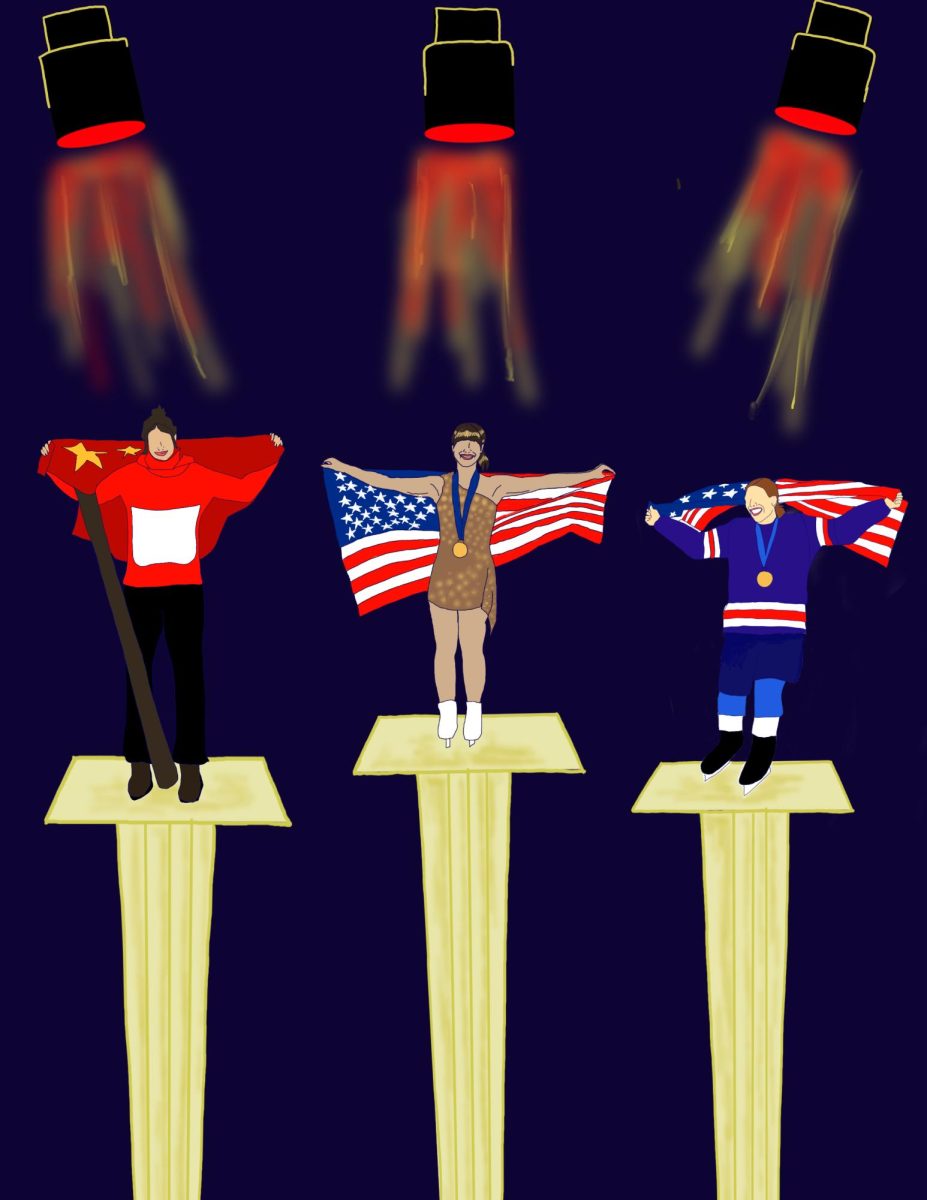
Alongside individual triumphs, the Olympics gave the USA women’s hockey team a platform as they dominated each opponent only giving up two goals the entire tournament. The team was on a mission to win gold, after they lost to Canada in the 2022 Olympic finals.
The final matchup with Canada turned into a well anticipated nail biter as the U.S struggled as they were down a point in the final stretch until they pulled their goalie. This gave them the opportunity to have a man-up advantage that was successful, sending the game into overtime. Shortly after, Megan Keller netted the final goal, winning gold for the team.
Since their victory, the Seattle Torrent, the current team of notable players like Captain Hilary Knight and Alex Carpenter, set a Professional Women’s Hockey League (PWHL) record of over 17,000 attendees, selling out Climate Pledge arena in a game against the Toronto Sceptres. Before the Olympics, the Torrent was averaging 11,234 attendees, resulting in a 54% increase since the Olympics.
Canadian teams the Ottawa Charge, Montreal Victoire, and Sceptras also reported sellouts, drawing crowds of 8,572, 10,172, and 13,264 attendees. In addition, monthly merchandise sales have been up 101%.
Unfortunately, this triumph for women’s hockey is overshadowed with public discourse surrounding President Trump’s misogynistic comments on a phone call with the men’s hockey team. The men’s team were later scrutinized by the media for laughing along and being bystanders to the comment.
Even though this controversy has placed Keller, Knight, and men’s players Jack and Quinn Hughes on late night shows such as the Tonight Show and Saturday Night Live, the moment ultimately shifted attention towards the men’s team at the expense of the women’s accomplishment.
While the initial comment from the president was irresponsible, the media response that followed reveals a broader pattern. Rather than centering the historic achievement of the U.S. women’s hockey team winning gold, coverage quickly pivoted toward the cultural drama surrounding gender politics.
The attention generated by the incident was supposed to signal progress, yet the narrative still revolved around men, even if it was critical.
Women’s Figure Skating
Alysa Liu secured the first gold medal for the U.S in women’s singles figure skating since 2002. She skated a beautiful program, but what was instead the media focus was her mindset. Liu described removing herself from the pressure of winning and keeping her expectations low in order to skate with pure joy.
Liu’s social media platform grew exponentially after her long program. This is not necessarily because she won, but because of her reliability, mindset, and being a figure of antithesis to the rigid standards often associated with figure skating.
For example, Liu was asked about whether she could beat her opponents representing Japan. Her response rejected the pressure when it comes to winning.
“I don’t think about stuff like that…” Liu said. “Whether I beat them or not is not my goal. My goal is just to do my programs and share my story and I don’t need to be over or under anyone to do that.”
The attention surrounding Liu’s refreshing perspective on competition and being grateful for any outcome, saying in a press conference, “there’s nothing to be lost [while being here]” represents a broader shift in sports culture. Mental health awareness is no longer being treated as a buzzword in sports. It is being embodied by athletes and actively contributing to their success.
That being said, there is an irony to Liu becoming a social phenomenon. Her easy-going personality and candid presence have made her widely likeable, allowing fans to see her more as someone they can identify with. She doesn’t care about presenting herself a certain way to mold her fame, it just happened to follow her.
She recently shared on her Instagram story on March 5. that she encountered an invasive crowd following her homecoming from Milan, illustrating a shift in her personal privacy.
After the Olympics, Liu discussed having this expectation of being a role model because of her victory. In an interview with People Magazine, she admitted that she’s “not really sure” she wants that responsibility, adding “I guess I am.”
Liu returned to figure skating with low expectations, just wanting to perform. She was not expecting to win, and then gain an explosive following. Now, she is anticipated at events, in interviews, and to say the next philosophical reflection about resisting pressure that will turn into the next viral moment.
She is placed on a pedestal by the media for being unconventional, yet that same pedestal risks undermining the normalcy and spontaneity that made her appealing in the first place.
The shift post-Olympics highlights how the athletes’ autonomy, especially women’s, starts to fade when entering the public spotlight.
Women’s Freestyle Skiing
Freestyle skier Eileen Gu also gained attention from her words at a press conference that broke down a reporter’s critical question about whether her results were “Two silvers gained or two golds lost.”
Her response was stern, yet eloquent, stating that the perspective was ridiculous considering her accomplishments and the high level of skiing she was competing at.
“Winning a medal at the Olympics is a life changing experience for every athlete. Doing it five times is exponentially harder. Because every medal is equally hard for me, but everybody else’s expectations rise,” Gu said.
Gu’s response went viral for showing composure in an attempt at being humiliated by a reporter. It signified the absurdity in expectations and exposed the superficial attitudes towards Olympic athletes from those who have never come close to competing at the highest level.
In addition, Gu has also been scrutinized for choosing to compete for China instead of the U.S., and then expected to comment on geo-political issues that have little to do with her performance as an athlete.
The exchange ultimately highlighted that the reporter felt emboldened to undermine Gu, despite her reputation as a thoughtful and independent athlete who has built success far beyond her sport, balancing elite competition with being a full-time student at Stanford, while also entering the fashion and model industry.
The growth of women’s sports has been unprecedented in this decade, however a double standard is reproduced even if it’s disguised as progress. Despite growth this decade, media coverage still chooses to emphasize storylines where women are framed less as competitors.
The Olympics have always elevated women’s sports and athletes, but as these moments show, recognition often comes with caveats. While women continue to deliver historic performances, the conversation too often shifts away from the game, but how women are presenting themselves to the public eye.