


On the first Friday of February, hundreds of Bates students plunge into the freezing depths of the Puddle. It is one of the College’s most iconic traditions. Yet many students choose not to participate, and the most common reason is simple: everyone seems to get sick afterward.
But why does everyone seem to get sick? Is it the freezing cold water, or could the Puddle itself be toxic?
On a crisp Saturday morning, we collected a sample of puddle water to investigate. We added plant material from nearby vegetation to provide nutrients for microorganisms and allowed the sample to sit for a week. This process, known as a hay infusion, helps replicate the natural environment of the Puddle and promotes the growth of microorganisms.
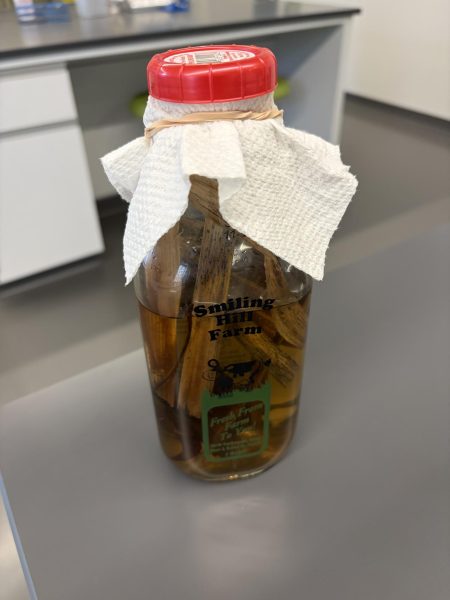
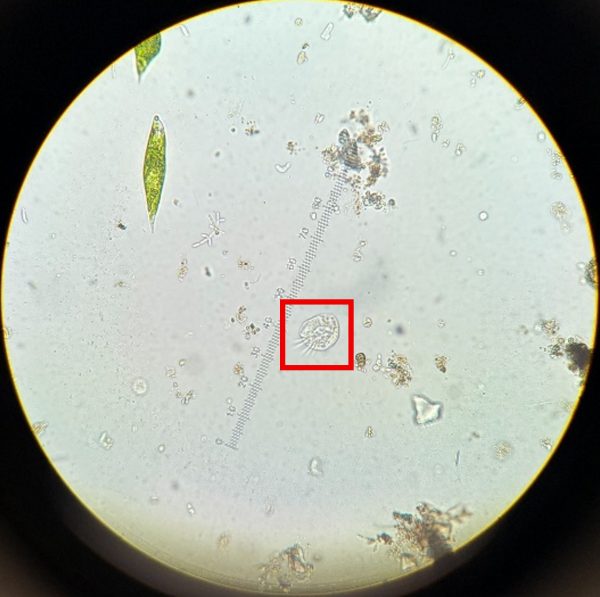
Afterward, we pipetted some of the water onto a microscope slide and examined it at 400x magnification. At this level, individual bacteria are still too small to see, but single-celled eukaryotic organisms are visible. Under the microscope, we observed two main types of microorganisms.
The first was Euglena, a tiny single-celled organism commonly found in freshwater ponds and lakes, like our Puddle. Interestingly, Euglena has both plant-like and animal-like characteristics. It contains chloroplasts that allow it to produce food through photosynthesis, but it can also absorb nutrients from its surroundings when light is limited. Euglena is harmless to humans and actually plays a beneficial role in aquatic ecosystems by producing oxygen and serving as food for larger organisms.
The second organism we identified was Cyclidium. This oval-shaped microorganism moved rapidly across the slide, making it difficult to photograph. Its speed comes from tiny hair-like structures called cilia, which it uses to swim and to sweep bacteria into its oral groove for food. Like Euglena, Cyclidium is harmless to humans and contributes to aquatic ecosystems by feeding on bacteria and recycling nutrients.
This investigation would not have been possible without the guidance of Bates biology professor Dr. Ifrah Shahi. She shared, “Next year, I’m planning on having my microbiology class collect Puddle Jump water on the day of the jump and examine it under the microscope. I wonder what they’ll find.”
There is far more life in the Puddle than most of us realize as we walk past it every day. Exploring this hidden microscopic world gave us a new appreciation for our surroundings.
So, if the water itself isn’t making students sick, what is?
The answer might be less shocking than we think. Although the microorganisms observed are essentially harmless, plunging into near-freezing water places a sudden stress on the body. Shocking temperature changes can trigger rapid breathing, elevated heart rate, and a spike in stress hormones. In these intense moments, this response helps you survive the icy water. But in the following days, your immune system may be temporarily impacted.
Research studies have shown that brief exposure to the cold, combined with other stress factors, can lower the immune system temporarily. This doesn’t directly make you sick, but it can cause you to be more susceptible to circulating viruses. During peak cold and flu season, this makes students especially vulnerable after a cold plunge.
In short, the Puddle isn’t toxic. It’s simply cold. When you combine ice-cold water, midterm season, and close contact with hundreds of people, a wave of sickness is bound to happen. The Puddle may leave us cold, but it also reminds us why we jump in the first place: community, courage, and a story we’ll tell long after winter ends.


