

EVERYBODY is a piece of modern dream theater that’s not afraid of getting weird. All the world’s a stage, but also a dream, and a presentation to God, which turns into an understanding of your own life.
Inspired by the medieval morality play “Everyman”, the performance asks the audience an age-long question in a novel way: what is the meaning of life? Spoiler alert: it doesn’t answer the question.
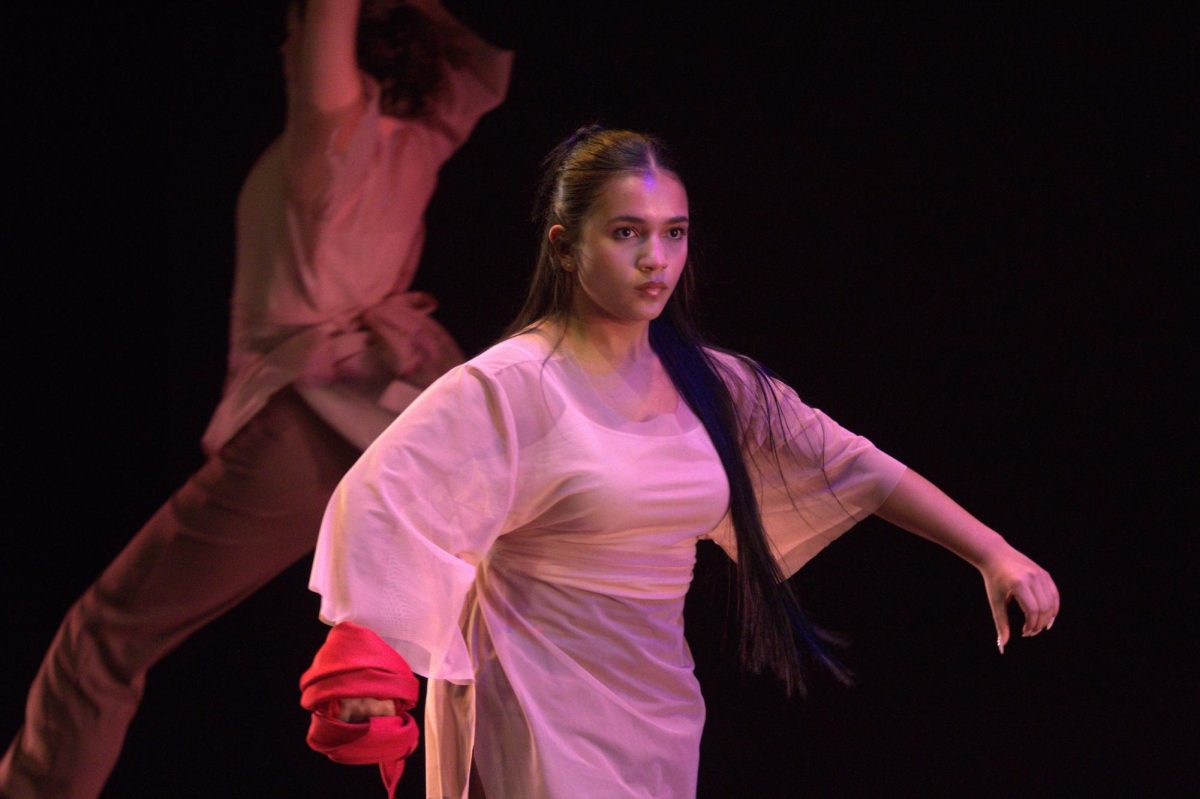
The play EVERYBODY, written by Branden Jacobs-Jenkins and directed by Professor Tim Dugan, opened on Thursday night, March 12th, in Gannett Theatre, which ran for a total of four nights, with two additional matinee performances on Saturday and Sunday. The play follows the journey of Everybody, who had been summoned by Death to give a presentation about how he had lived his life to God. Everybody is allowed to take Somebody with him, and they encounter Somebodies as abstract archetypes including Friendship, Kinship and Stuff, as our protagonist attempts to convince them to follow him into death. All roles were determined by a live raffle system early in the performance and played by a member of the Somebody cast, meaning no two nights of the show were the same!
It is no small feat to pull the audience collectively into a theatrical dream, requiring a culmination of efforts from the cast, director, multi-media, set and sound design. The play takes over the Gannett blackbox, which has been transformed into a mundane, modern room with 16’’ walls resembling a dentist’s waiting room, drawing the audience to settle into allegorical surrealism from the get-go.
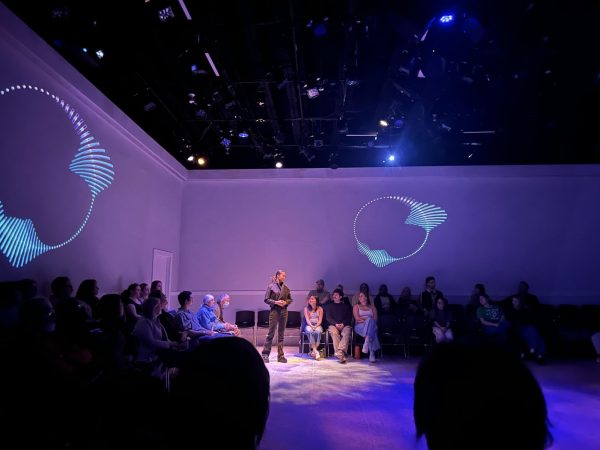
We soon realize that the line between reality, theatre and dream is blurred, as the usher becomes “God,” speaking through a booming pre-recorded voice of omnipotence. Undercover actors hidden amongst the audience are dragged onto the stage, and the play rolls on in full motion as Death reveals themselves. Dugan’s EVERYBODY is a production that’s aware of its transient genre, its use of media, and its randomness in the lottery of life.
This play is an instance where the production exceeds the confines of its playwriting. The morality play adaptation attempts for a modern and comical approach to the dreary questions of existence, a bathetic fall from the traditional heaviness around these topics. I walked away without much lingering on my mind thematically, though entranced by the technical brilliance of the production.
EVERYBODY demanded a lot from the actors, as most roles for the night were determined in the opening scenes of the performance. Despite the strenuous amount of memorization, the performances of all roles were carried out perfectly; even actors who were assigned a smaller role that night delivered their limited lines with personality and flair. Actors grounded abstract archetypes into something tangible and relatable, especially in parts of the production that captured some of the very human, shared experiences in kinship and friendship. We’ve all heard the “vague yet affirmative family motto;” familiar with the inside jokes with our friends about “that one time with that one person.” However, the comical nature of these cartoonish bits drew me away from contemplation altogether, rather than sparking new interrogations.
One of the central challenges of the play was balancing universality with relatability. In an interview with The Student, Dugan shared that while the allegory “gave us the permission to be symbolic, how do you find humanity within the concepts?” Dugan explained that the “meta-theatrical” elements all encouraged contemplation on life, death, and the space in between: the limbo where EVERYBODY takes place.
The technology that enabled these metatheatrical elements was in no small part due to the IMPACT 21 grant. IMPACT 21st (Innovation, Media, Process, Arts, Collaboration and Technology for the 21st Century) is a grant that “promotes new technical and presentational approaches to teaching and learning in the arts” at Bates. Until IMPACT 21, Dugan shared, Bates did not have the opportunity to create a play as technologically advanced as EVERYBODY. EVERYBODY was brought to life by Courtney Smith (Production Manager, Scenic and Projections Designer, Lighting Design Academic Advisor) and guest Sound Designer Emily Wilson, who held the audience captive in the dream of EVERYBODY with intricately designed projections and seamless voiceovers.
However, the use of technology and multi-media in this play became overbearing at points. A large portion of the play was delivered through pre-recorded monologues projected onto the walls surrounding the audience. Novel, inventive, and intriguing at first, these monologues quickly became distracting for me. The recording held some of the most introspective observations of Everybody’s life, and I couldn’t help but feel these speeches would be more effectively conveyed in embodied performances.
The challenges of such a play, however, gave rise to more actor involvement in the production. In many ways, Dugan said, this play felt like devised theatre, where the entire ensemble was able to pitch in. Challenging enough as the play sounds, the Bates production actually included four more Somebody actors than the original script intended, an increased variability that brought new lives to different characters.
The production of EVERYBODY felt like a declaration of what could be done in the coming years of Bates theatre productions. Though the script fell short of the production, it showed us the potential for diverse, innovative and stunning multi-media productions that ushers us into a new age where technology and art can work together in pursuit of answers, or further questions.